
Executive Summary
For years, the “Creator Economy” was synonymous with “Content Economy.” You made videos, photos, or blogs, and fans consumed them passively. But in 2026, the market has shifted. Access is the new currency.
Fans are no longer satisfied with just watching you; they want to know you. This shift has given rise to “Direct Interaction” platforms. But not all monetization tools are created equal. Some turn you into a content factory, while others turn you into a commodity.
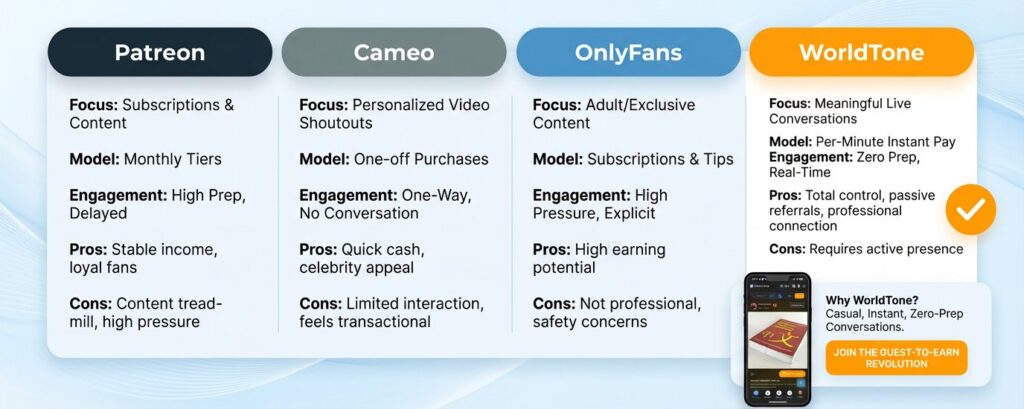
This report compares the four dominant models for creator monetization—Patreon, Cameo, OnlyFans, and WorldTone—to determine which platform offers the best balance of income, freedom, and genuine connection.
1. Patreon: The “Subscription” Model
The standard for funding creative projects.
Patreon popularized the idea of fans paying a monthly fee for exclusive perks. It essentially allows creators to run their own private Netflix service.
The Experience:
It acts as a gatekeeper. Fans pay $5 – $20/month to access a private feed, Discord server, or bonus episodes.
✅ The Pros:
- Predictable Revenue: Recurring monthly income helps with financial planning.
- Community Building: Great for fostering a group mentality among fans.
- Creative Freedom: Allows you to make niche content that advertisers might hate.
❌ The Cons:
- The “Content Treadmill”: To keep subscribers, you must constantly produce new bonus content. If you stop posting, people cancel. It creates a high-burnout environment.
- Passive Interaction: While it has DMs and comments, it is not designed for live, 1-on-1 interaction. You are still broadcasting to a group, not connecting with individuals.
2. Cameo: The “Shout-Out” Model
The standard for quick, transactional celebrity messages.
Cameo turned selfies into a product. Fans pay a flat fee for a 30-second pre-recorded video message (e.g., “Happy Birthday, Dave!”).
The Experience:
It is strictly transactional. The fan sends a request; the creator records a monologue.
✅ The Pros:
- Low Effort: It takes 60 seconds to record a video.
- High Volume: You can bang out 20 Cameos in an hour.
- Zero Commitment: Do it when you want, stop when you want.
❌ The Cons:
- It’s Not a Conversation: There is no back-and-forth. It’s impersonal.
- The “Gimmick” Factor: It works well for B-list celebrities or novelty acts, but it’s hard to build a sustainable business as an expert or teacher.
- Revenue Cap: There is a ceiling on how much people will pay for a 30-second birthday wish.
3. OnlyFans: The “Pay-Wall” Model
The giant of monetization, specifically for adult/glamour content.
While they have tried to pivot to “cooking and fitness,” OnlyFans remains dominated by the adult industry. It combines subscriptions with Pay-Per-View (PPV) messages.
The Experience:
Fans pay to unlock photos/videos or pay to send DMs (which are often answered by hired ghostwriters, not the creator).
✅ The Pros:
- Massive Revenue Potential: The top 1% earn millions.
- Aggressive Monetization: Features like “Tip to DM” are highly effective for extracting value.
❌ The Cons:
- Brand Stigma: Being on OF can disqualify you from mainstream brand deals and sponsorships.
- The “Parasocial” Trap: It often monetizes the illusion of intimacy rather than real connection.
- Ghostwriters: Fans are becoming increasingly aware that they aren’t actually chatting with the creator, leading to trust issues.
4. WorldTone: The “Live Consultation” Model
The new standard for meaningful, real-time connection.
WorldTone positions the creator not as a content factory or a celebrity, but as a Consultant or Expert. It facilitates live, 1-on-1 video calls paid by the minute.
The Experience:
It is FaceTime with a meter. A fan books a time (or calls when the creator is online), and they have a real, two-way conversation.
✅ The Pros:
- High Hourly Rate: Creators set their price (e.g., $2/min = $120/hour).
- Zero Prep Work: Unlike Patreon, you don’t need to edit videos or write posts. You just show up and talk.
- Authenticity: It is live video. No filters, no edits, no ghostwriters. It builds the deepest possible bond with a fan.
- Smart Scheduling: You aren’t “on-call” 24/7. You set your hours, and the app handles the rest.
- Dual-Mode Economy: Unique to WorldTone, you can also earn by being a guest (Guest-to-Earn), creating a dynamic where value flows both ways.
❌ The Cons:
- Active Time Required: You have to be physically present to earn (it’s not passive income like a Patreon archive).
Verdict: Why WorldTone is Best for Meaningful Connection
If your goal is to churn out content, use Patreon. If your goal is to sell a quick birthday wish, use Cameo.
But if your goal is to monetize your expertise, personality, and genuine relationship with your audience, WorldTone is the superior choice.
Here is why WorldTone wins the “Connection Economy”:
1. It Validates the Fan
On Cameo, the fan is a customer buying a product. On Patreon, they are a subscriber supporting a channel.
On WorldTone, they are a Guest. When you look them in the eye and answer their specific question live, you validate their existence. That creates a “Superfan” for life.
2. It Solves the “Content Treadmill”
Creators are tired of editing. WorldTone allows you to monetize your personality without the overhead of production. Your inventory is your time, not your MP4 files.
3. It Professionalizes the Interaction
DMs are messy. OnlyFans carries stigma. WorldTone offers a clean, professional environment (like a digital office) where asking for payment is built into the infrastructure, removing the awkwardness of asking to be paid.
Conclusion
The future of the Creator Economy isn’t about more content; it’s about deeper context.
WorldTone is the only platform designed to facilitate high-value, low-friction, face-to-face interactions. It turns your influence into a sustainable service business.